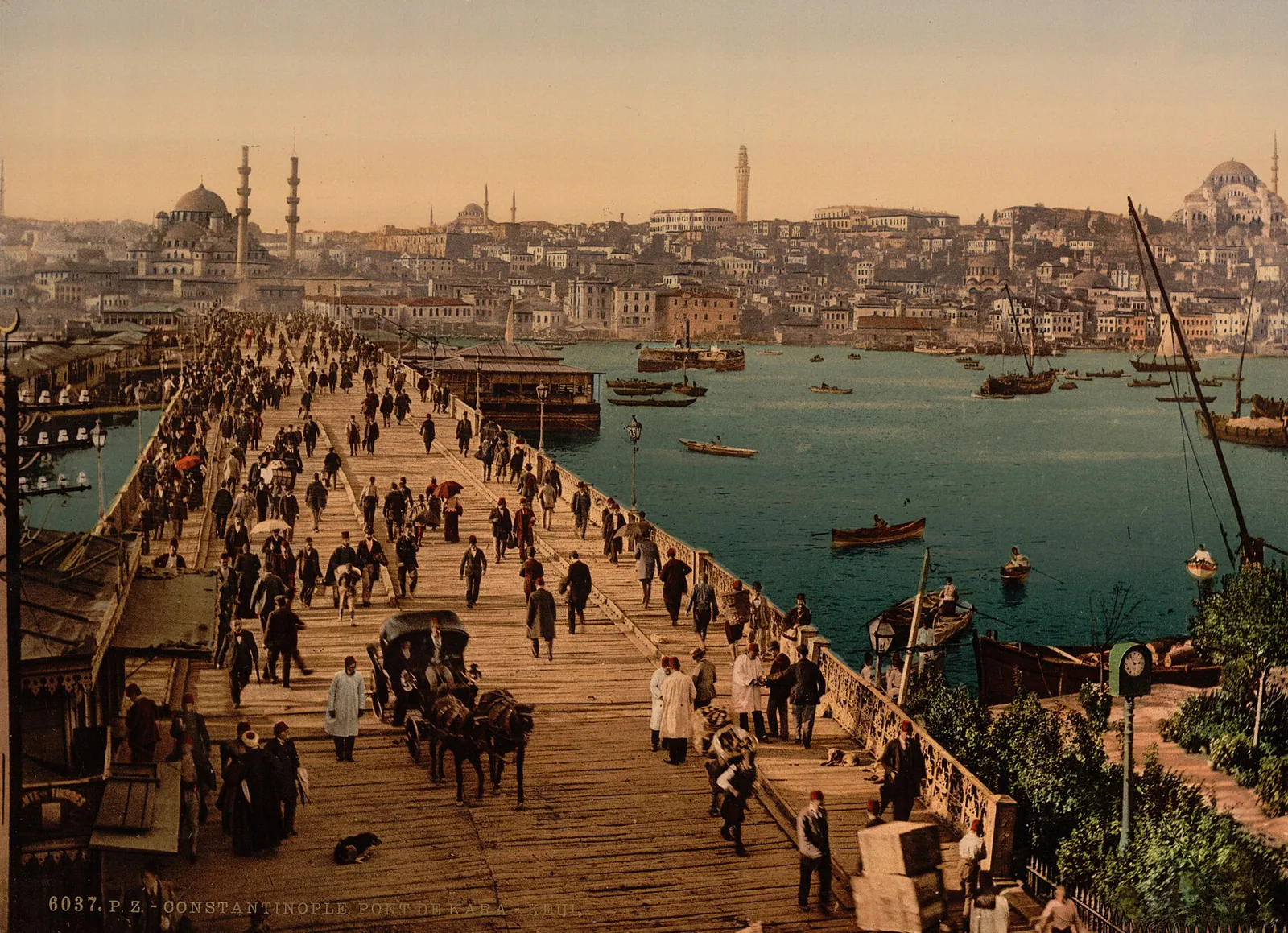
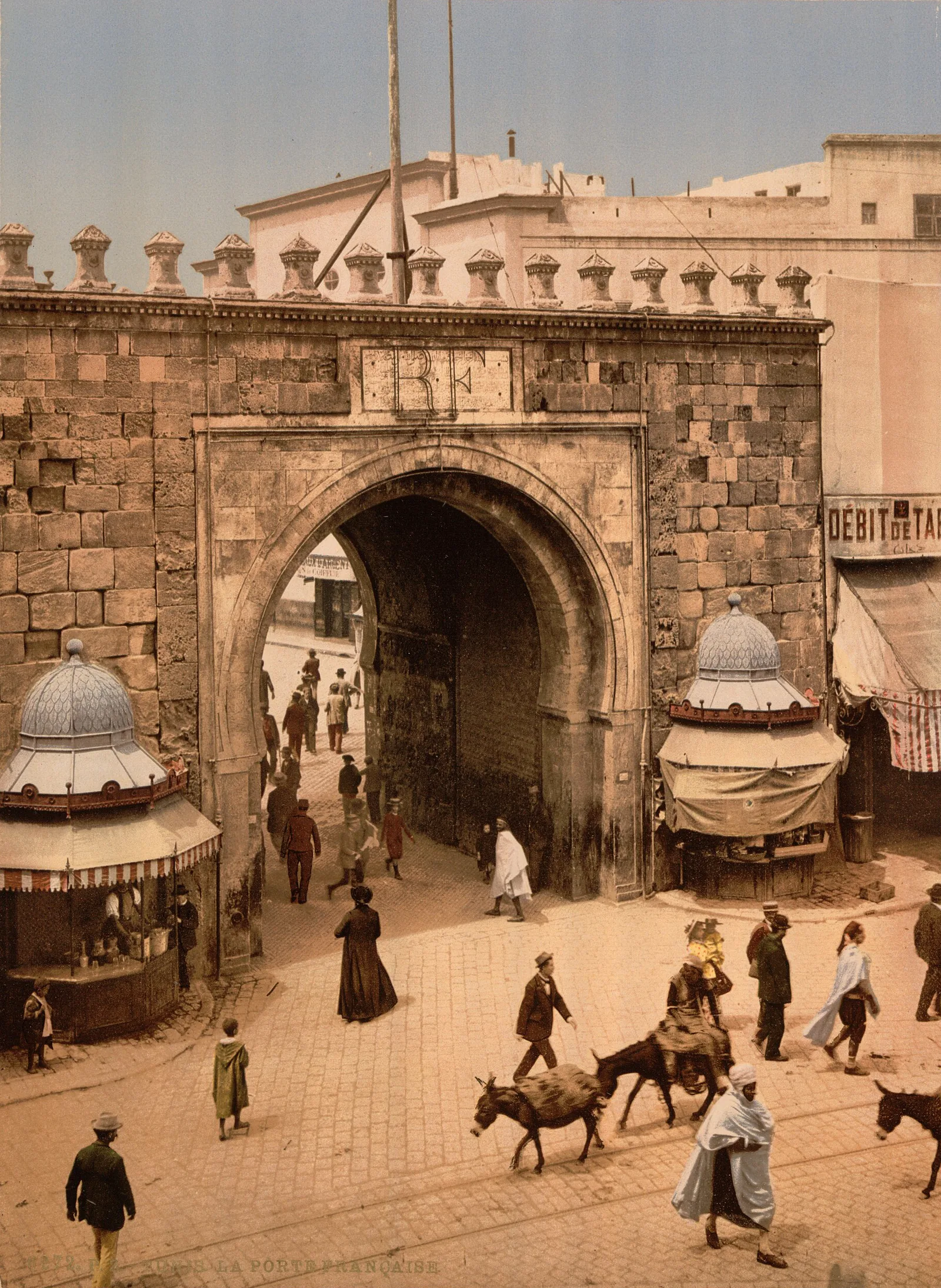
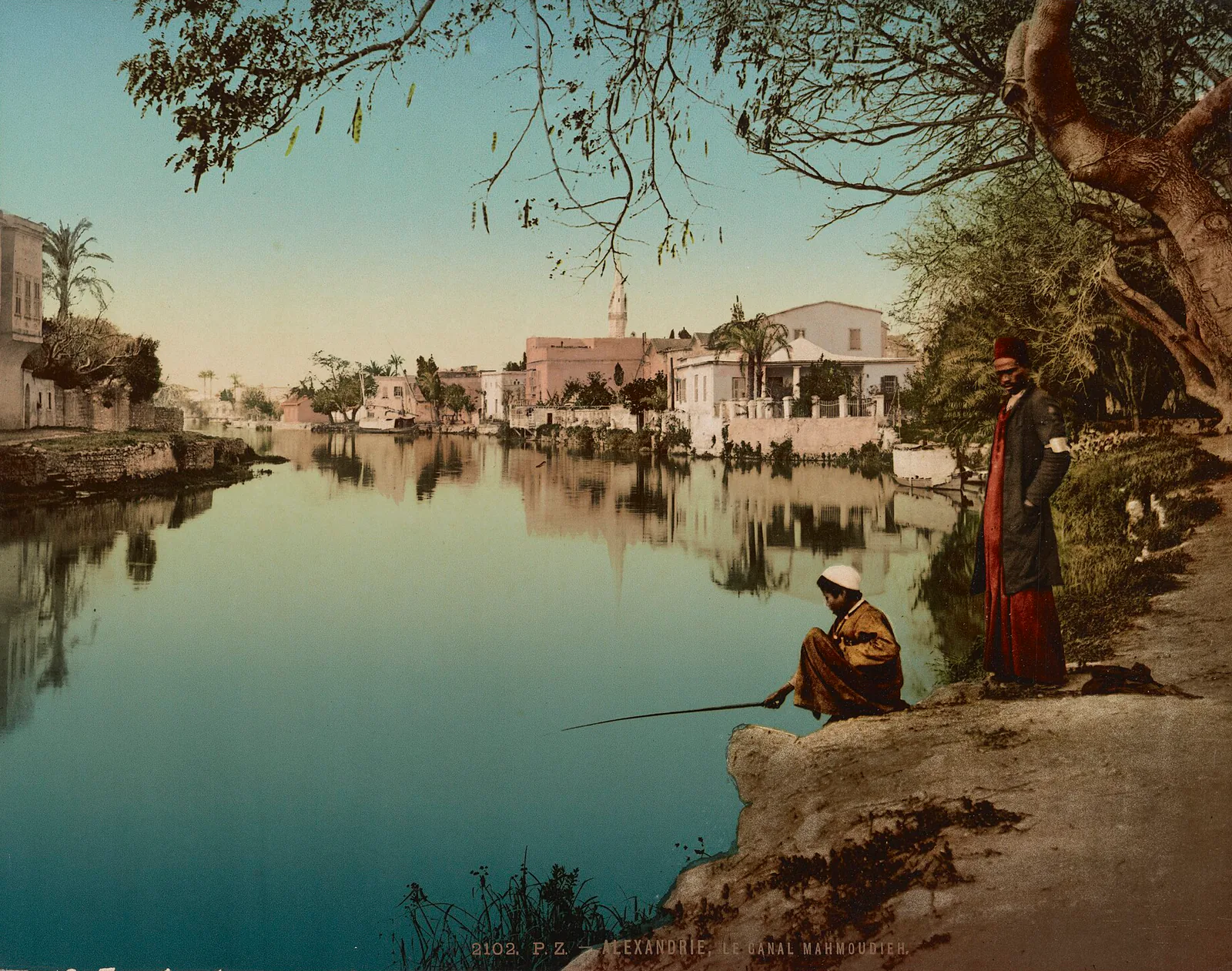
At the foot of the Porte de France plate, in Tunis, two letters are printed into the image itself, between the serial number and the place name: P.Z., for Photoglob Zürich. The same abbreviation turns up under the Kara-Keui Bridge in Constantinople — the city we know today as Istanbul — and under the Mahmoudieh Canal in Alexandria. Three cities, one signature cut into the lithographic stone: the trace of an industrial chain that produced most of what we now call a photochrom, from the late nineteenth century to the First World War.
A Zurich invention, sold to America
The technique that gives a photochrom its colour — a single black-and-white negative, hand-transferred onto tinted lithographic plates from the photographer's notes rather than from any recorded colour information — was developed in Zurich in the 1880s by Hans Jakob Schmid, an employee of Orell Füssli, a printing and publishing house founded in 1519. In 1889 Orell Füssli spun off a dedicated company, the Photochrom Co., to license Schmid's invention worldwide; from 1895 the plates went out under a separate trade name, Photoglob, which is the name that stuck to them rather than the parent firm's. We cover the process itself at greater length in our piece on the photochrom.
An American licence, a disputed date
By the late 1890s, two Americans — William A. Livingstone Jr. and the photographer-publisher Edwin H. Husher — had founded the Detroit Photographic Company to put the Swiss process to work at industrial scale: black-and-white negatives converted into colour images and run off by photolithography, a Zurich invention turned American business. Exactly when they secured the licence is not settled between the sources we consulted: the German Wikipedia dates it to around 1898, while the English one dates the licensing of "other companies, including the Detroit Photographic Company" only to the mid-1890s, without naming a year.
The firm grew fast. Late in 1897, Livingstone persuaded the photographer William Henry Jackson, formerly of the United States Geological and Geographical Survey, to join. Jackson brought with him thousands of negatives: views of cities, notable buildings, scenes shot along the railway lines, hotels and resorts. In 1905 the company took the name it's best known by, the Detroit Publishing Company. At its peak, it offered ten to thirty thousand distinct views in its catalogue and sold, in some years, as many as seven million prints. The war cut into sales, cheaper printing methods drew customers to competitors, and the company went into liquidation in 1924, closing out its last assets in 1932.
What mass production did to the pictures
A publisher selling seven million prints a year no longer works the way a travelling photographer chooses a view on a whim. It sends operators out on assignment with a list of subjects that will sell — a bridge, a fortified gate, a canal, a market, an arcaded street — then ships the negatives back to the Zurich workshop or the American press, where no name is signed to the image anymore. What the company chose to photograph in Tunis, in Constantinople, in Alexandria was whatever a European or American traveller of 1900 was willing to carry home as a postcard or a framed print: a recognizable, picturesque motif that fits inside a frame without needing a scholarly caption. The resulting catalogue of ten to thirty thousand views says as much about the gaze trained on these cities at that moment as it does about the cities themselves — and it's that gaze, more than a precise date or an architect's name, that our prints carry to the wall.
One hand, three cities
The Kara-Keui Bridge, spanning the Golden Horn between Galata and Stamboul, shows exactly what the operator had come for: a deck packed edge to edge, a continuous crowd of fezzes and bowler hats, porters bent double under their loads, steamer pontoons lined up along the quay. The Yeni Cami and its two minarets close the skyline behind it.
In Tunis, the Porte de France gives the same subject in a different key — but this plate also dates its own gaze: above the arch, the "RF" cartouche of the French Republic; to the right, a sign reading "DÉBIT DE TABAC," a tobacconist's. A landmark a traveller would find again, almost unchanged, on the postcard bought the next day.
In Alexandria, the Mahmoudieh Canal moves the motif onto water, and here the workshop follows its own taste to the end: the water sits perfectly still, mirroring the bank, a large tree leans into the frame overhead, a child fishes from the shore with a line. No traffic at all — the canal reads here as landscape, not as a waterway.
A collection that ended up in Washington
The Detroit Publishing Company's negatives and prints scattered after the liquidation, and most of them reached the Library of Congress in 1949. Its photochrom collection proper was assembled separately, in two stages: in 1985, the purchase of the European and Middle Eastern views from the Galerie Muriset in Switzerland; in 2004, the gift of the North American views from Howard L. Gottlieb. Close to six thousand European and Middle Eastern views now sit alongside five hundred North American ones, spanning countries from Norway to Tunisia by way of Turkey and the Holy Land. Each of our three plates — Tunis, Constantinople, Alexandria — carries one of that library's call numbers, legible in the name of the file it was scanned from.
Not every plate in our collection follows this chain
The credit "Photoglob Zürich — Detroit Photographic Co." doesn't cover our whole collection. Some of our prints come from other archives and other processes altogether — the Bibliothèque nationale de France, the Rijksmuseum, the Matson collection — albumen prints and photographs that never passed through a Zurich workshop at all. The chain described here accounts for part of what we hang, not all of it: it explains why so many of our Mediterranean and Black Sea views share a single hand, not why every plate in the collection exists.